Sunday, July 22, 2007

How fast time goes by, a year ago this week I was stepping off an airplane and starting my Peace Corps service. The feelings of excitement and nervousness surged through my body as I discovered Benin and got to know Africa for the first time. I left a good job in the Department of State and I gave up a great relationship with a wonderful girl to pursue my crazy idea of joining Peace Corps. But since the day I arrived to Africa I have been very lucky in everything that I have done. My host family with whom I lived with when I first arrived turned out to be wonderful, the town that I live in is very nice, clean, and scenic and in my opinion the best town in Benin. Peace Corps Admin in Benin is great, I have made many friends and I am very proud of the work that I have done.

I am very fortunate to have very ambitious work partner. Yacaobou Moussa,(pictured above) is a leather smith by trade with a simple 6 grade education but he is the most determined person that I have met. He is also the president of the handicap association of my town and together we have taken an old cargo container and turned it into a clean water production facility. As of June of 2007 we are employing three handicap people, by producing clean filtered water and selling water in small water bags at a very cheap price to the public, we have recently started producing flavored water such as tamarind, hibiscus, lemon, and local exotic fruits with the profits the handicap association is paying for health needs of handicap people in town. It is an amazing feeling to be part of this project and seeing an old container turned into a facility that produces clean water, employs handicap people and making money.


Another project that I am very proud of is having an English and Spanish club in the local high school. Students are very interested in learning English, so my postmate Richard and I applied for a small grant from USAID and with the assistance of Abel; a local English teacher we prepared a regional English competition that focused on HIV/AIDS prevention and awareness. With the money we received we gave out the test to over 250 students in 23 schools throughout the region, the top 80 students and top 7 teachers came to our town of Natitingou and we gave them another exam with the focus on HIV/AIDS and then had an awards ceremony with a play and presentation on HIV/AIDS prevention afterwards we gave the students, books, dictionaries, school material, money and paid for next school year’s fees. The English Competition was a huge success and the kids had a great time.

By far the greatest reward comes from working with the local orphanage and an NGO that helps children especially girls go to school. With a couple of dollars we have fed over 80 orphans for Christmas and bought clothing for them and with the NGO we have purchased books and uniforms to help underprivileged kids go to school and encourage the education of girls in small rural villages.

At times things are a little difficult because if people see you do a project with somebody, some get jealous and expect the same attention and effort, many just want a handout because they think I have money to give away, others want me to do a project with them but they are not willing to put in the time and effort they expect all the work to be done for them. Overall I have been very blessed with everything I have done so far, I have already accomplished so much this year and I already have plans for my future projects, I am in the process of raising money to build an adult education classroom for my town, so expect an email from me asking you to please donate some money to my project or please check back in the near future for more info and details.

Tuesday, July 17, 2007

Another popular tourist attraction in Benin is Ganvie, a village built on a lake an hour from the capital. Think about it as Venice in Africa. Stories tell that in the 17th century Kings of Abomey were waging war on their neighbors and capturing people to sale to the white men as slaves. Since the king’s soldiers could not swim, the people built themselves a village on the water, and they were thereby safe from the persecutors. Legend says that the people made a deal with the animals of the lake and they were helped by crocodiles to swim to the middle of the lake and other animals taught the people to build houses on the water to fish and farm in their new environment.
I was recently in Cotonou, the pseudo capital of Benin when a couple of friends and I decided to go to the water village of Ganvie. Like I have ranted before Cotonou and the surrounding communes are some of the dirties and worst organized places that I have seen so far in Africa, and Ganvie was no exception, the place leading to the entrance was heavily polluted with trash, the road is in deplorable condition, the people come running up to tourist begging for money or to buy some incredibly over priced souvenir, and there was a horrible stench of trash and dead fish, for a popular tourist attraction this place is rundown and it seems as very little money is reinvest in the development of this national treasure, and this is sad cause it is probably the largest lake village in Africa and a very popular tourist attraction, I am sure that there is a lot of money being earned from this that locals are not seeing any benefit from.

That was just the entrance, after we payed for our boat we started our trip to the actual village, we started seeing little wooden fishing boats, most were aged and beat up cause while one person rowed another was responsible taking the water out of the boat, sometimes there was one person doing both. The sails were made from old blankets or from empty rice and corn sacks sown together. After about 30 minutes in a motorized boat we started seeing rough make-shift houses of old planks and straw on stilts, the closer we got we started seeing more and more till it looked like an actual village on water. The actual village of Ganvie is nice, very picturesque, with colorful wooden houses, people conducting everyday business but on boats, the market was a cluster of boats and people rowing to buy and sell, people transporting animals and random things to sell.

Aside of the people who sold stuff to tourist the people of Ganvie were very defense about not taking their pictures, the pictures I have of people I had to take very discreetly. Actually the people of Ganvie were not that nice to the tourist, kind of strange considering that this is one of Benin's most popular tourist attraction and the village lives of tourism and fishing. But after a couple of minuets of being in Ganvie I could completely understood why. Tourist come in in loud motor boats that scare the fish and create waves that unbalance their little boats, then tourist go around taking pictures and viewing people and the place as a zoo attraction and invade in their personal space and everyday lives, I too would get upset if people came to my town and treated me and my town like a zoo or tourist attraction, and like I previously mention the village does not see much of the profits that is earned from their town. But overall Ganvie was very nice and I am glad I have the chance to see it.

Tuesday, June 26, 2007

Damn, I had a couple of articles and a bunch of pictures I was going to to post but I lost my USB key with some work including a project for a grant to build an adult education center that I had been working on for days. But nothing I can't do over again, and I was able to salvage a couple of pics that I wanted to post.

I had written an article on the cultural diversity of Africa, on how many different languages, and the cultures that can be found in West Africa and the different types of scarifications and tattoos that they use to distinguish each other or to represent what tribe they are from.

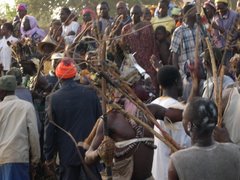
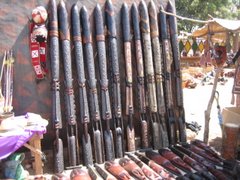
Since I have arrived to Africa nothing has fascinated more than the faces I have seen, and these pictures are only but a few examples. The pictures will tell the story.


Wednesday, June 06, 2007

Voodoo 101

First off, forget about everything you ever learned about voodoo from Hollywood, sorry to disappoint and let you down but no zombies and living dead here. Benin is the region where Voodoo was born, during the slave trade many of the slaves that went to the New World such as Brazil, Haiti and the United States came from what is now known as Benin. Since Christianity was forced down their throats by Western colonizers, slaves merged their native believes and traditions with Christianity and along the way somethings changed and voodoo was born. From what I have learned, I am going to try to do the best to explain what voodoo is, I am sure I am going to get somethings wrong but it is hard to get this correct since there is no written history and stories change from region and according to people, so take what I say with a grain of salt.
The best way I can explain voodoo is to compare it to the Native American religious believes, that the world is alive, that spirits are all around us, our dead ancestors are not dead but they are among us in different forms. Those spirits can protect us, bring good fortune and prosperity or the spirits can be vengeful and bring bad luck and hardship. We can contact the spirits through certain actions and rituals and there are certain people who have been given the gift of talking to spirits. These people will go into a trance and communicate with the spirits. There is a national holiday in January that celebrates voodoo and people gather in Ouida, the cradle of voodoo, where people dance in a trance and slash themselves with knives and brake bottles on their heads to prove that their body is in this world but their spirits are in another world.

Voodoo in Benin is known as Grigri. Grigri is very present in the everyday lives and the people still hold a very strong believe that grigri plays a part of their lives, a large portion of Africans are animist and have combined Islam or Christianity to their believes but grigri is seen in the biggest to smallest details of their lives. For example certain hospitals in rural and medium size town will have grigri as a cause of death on their death certificate. It is common to see mud statues that represent deceased members of the family and depending the size and accessories that the statue has, you can tell how important the person was, but the actual purpose of the statue is to represent that the person is still among the living. Sweeping after sundown is seen as taboo, cause the spirits come out at night and sweeping might anger the spirits. Going to the outdoor markets is a very interesting experience, there are grigri sections where you can find monkey bones, animal skins, dried animals potions made of god knows what, and various types of strange roots and herbs, there are also markets that sell nothing but grigri objects.

Sunday, May 20, 2007

Peace Corps pays Benin volunteers more or less 220 dollars a month, this is practically nothing to the average American, but in contrast to the average Beninese salary we are making big money. We get paid every three months, and if you’re anything like me who loves to travel, blow money and have a good time, you will find yourself broke very soon and anxiously awaiting next pay check. When we were in Ghana and Togo I went all out and made sure I had a great time but as a consequence after our trip, I was broke and running on fumes.



Back in my town, a couple of days when a good friend; Sarah, calls me telling me that her parents are in Benin visiting her for a couple of days, and they want to go on safari at the national park Pendjari which is about 2 hours from my town, people from across the world come to go on safari, and I have not had the chance to go because its too expensive and I am always broke or we have also tried to go but for one reason or another things never workout. When Peace Corps Volunteers go on safari it is usually for half-a-day because rooms and guides are ridiculously expensive, since it is catered to tourist who can afford it. Sarah tells me that they are going to spend two nights and three day at the park, she offers that they will pay for everything all I have to pay is the entrance fee, which is around 20 dollars. How could I say no to that?
How lucky am I? Very.

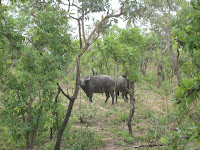
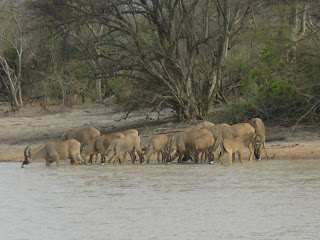
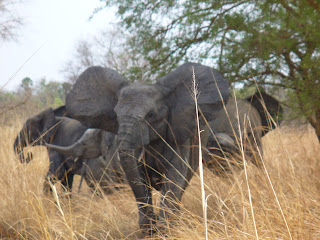
Parc National de la Pendjari is a 275,000-hectare national wildlife park is par excellence in this part of West Africa for spotting lions, elephants, baboons, leopards and hippos. The best time to go is around the end of the dry season from November till April when animals start to hover around the water holes, but in May the rainy season starts and everything starts to get green, trees, shrubs and the vegetation starts to grow and animals are less likely venture out and be seen, so we were told that we might not get to see as many animals and at first we did not see too many but after a couple of hours of riding around on top of an uncomfortable Toyota 4-Runner that soon changed. We were also fortunate to spend three days in the park so we were able to see lions, elephants, warthogs, hippos, monkeys and baboons, various types of deer, caribou, antelope and birds of all sizes and colors. Since it is the beginning of the raining season, food and water are abundant so it is also the birth season for animals; we got the chance to see just about everything baby, baby warthogs, baby hippos, baby monkeys etc and no matter how fat and ugly the animals are as adults, as babies they are all cute. It was interesting to see baby monkeys come close to the car and look at us with such curiosity and then runaway. I was amazed by the diversity of birds there are, small birds to huge birds that were easily up to 5 feet tall, birds of all colors, from dull brown to the brightest blue and red with shades and combinations of various colors. The elephants were the highlight of the safari, African elephant are huge and fearless, while other animals ran or flew at our sight the elephants would walk right by us or continue what they were doing without even bothering to acknowledge us, we saw a herd of 4 elephants playing on a puddle and wrestling.


The third and last day of our trip, we were all tired and ready to head back so we spent half the day on safari and then in the African heat of the afternoon we went swimming in the waterfalls that are at the entrance of the park. None of the pictures that I have posted or taken can justify actually seeing the animals and scenery of Africa.

I would like to thank Mike and Fran Haskins for making this adventure possible.

Saturday, April 28, 2007

The life of an African is hard, but the life of African women is very tough.
Since I arrived to Africa one of the first things that I noticed was that the life of African women is very difficult, burdensome and faces many obstacles at any age. At a young age African girls have a hard life, around the age of 5, young girls are responsible for taking care of their younger siblings, cooking cleaning doing laundry or selling water or fruit on the streets. It is typical to see young girls with babies strapped to their back, while doing chores or walking down the street with a large heavy tray filled with fruit. The chores they do are not as simple as the chores we have in the States or the developed world. For example, most houses do not have running water, therefore the girls have to go to wells or water pumps that are usually far and carry large basins of water on their head on a daily basis. There are no supermarkets or refrigerators so everything they cook has to be made from scratch, if the family wants to eat chicken, they are going to buy it, kill it, clean it and cook it. Houses are made of mud that easily crumb, so sweeping and cleaning the house can taking all day, washing machines do not exist here, and washing cloths by hand is a tedious job that wears down your hands, people are too poor to afford gas stoves, so just getting a fire started with wood or charcoal takes effort and time, these are just a few examples of daily chores that girls are expected to do.

Education is not an option for most girls. Predominately families in villages do not send their daughters to school, because spending money and time on their education is seen as a waste since girls are usually married off at a young age and start having children. Parents think that girls are more valuable working at home and learning the skills of a wife, mother and caretaker. Schools in the cities or bigger towns are more likely to have more girls go to school, but as the grade level goes up there are fewer girls present. For example from 1st grade to 5th grade there are likely to be an equal number of boys to girls but, from 6th grade to 10th grade there are a couple of girls and beyond that there is only a handful. Then girls also face problems like teachers sleeping with them, getting them pregnant and leaving them, I was very surprised to find out that this is a common occurrence throughout schools in Africa.

Life only gets harder for women, they marry willingly or by force by their early to late teens, and then they start having children. In villages men have up to 4 wives; usually the fourth is a young adolescent girl. Health volunteers have told me that African women cannot refuse their husbands, and their husbands do not want them on birth control so the consequence is that they will have one child after another and this takes a heavy toll on their bodies, but not even childbirth slows them down, they can have a baby one night and be back to cooking, chopping wood, doing chores and tending to their husband the next day. African women are incredibly strong in so many ways, they have the strength to strap a baby to their back and carry up to half their weight in coal, tree branches, logs, water, and other things on their head for long distances. On market days you can the parade of women with bright colourful clothing with incredible amounts of weight on their head to sale at the market. In bigger towns and cities girls can only find jobs at bars that pay minimum wage which is practically not a damn thing, tipping does not exist in Africa so they turn to prostitution or have to put up with the shit of stupid drunks hitting on them, because this is the only source of income to feed their children or family.